
In this article· 8 sections
- 01What the central kitchen model actually is
- 02Central kitchen vs outlet kitchens: the real trade-offs
- 03What a central kitchen costs, and where it saves money
- 04Worked example: does a central kitchen pay off for 4 outlets?
- 05When the central kitchen model makes sense: a checklist
- 06Which items to move to the central kitchen first
- 07Common mistakes when moving to a central kitchen
- 08How Parchika helps run a central kitchen
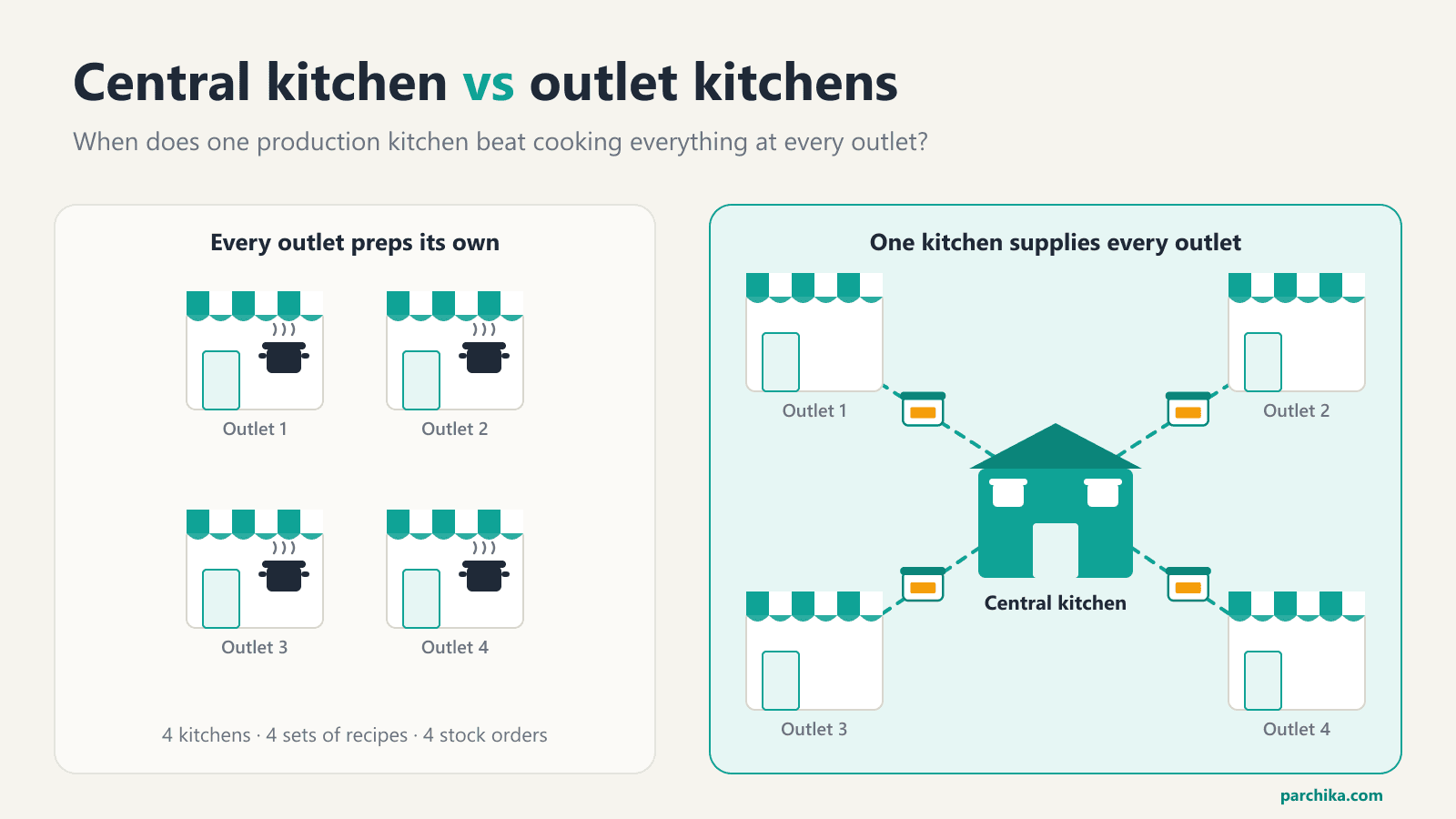
You have three or four outlets now, and every one of them makes its own gravies, sauces and doughs. The butter chicken tastes slightly different at each location, two outlets ran out of marinade last weekend, and your best cooks spend half their shift on prep instead of service. Somebody has suggested a central kitchen.
The central kitchen model moves bulk preparation into one production kitchen that supplies every outlet. It can fix consistency and cut waste, but it also adds rent, transport and a new layer of planning. This guide explains how the two models differ, what a central kitchen really costs, how to work out whether it pays off for your chain, and which items to move first.
What the central kitchen model actually is
A central kitchen (also called a commissary kitchen or base kitchen) is a production kitchen that does not serve customers. It prepares base gravies, sauces, marinated proteins, doughs, batters, desserts and pre-portioned items in bulk, then sends them to outlets. The outlets finish the food and serve it.
In the outlet kitchen model, each restaurant buys its own raw materials and does all of its own prep and cooking. Nothing moves between locations except, occasionally, emergency stock.
Most chains end up somewhere in between. A typical split looks like this:
- Made centrally: base gravies, sauces, chutneys, marinades, doughs, batters, desserts, bakery items.
- Finished at the outlet: anything fried, grilled or assembled to order, fresh salads, garnishes and drinks.
The rule of thumb: centralise what is labour-intensive, needs consistent taste or benefits from bulk preparation. Keep at the outlet whatever loses quality quickly after cooking. If you want the full picture of how production is planned once you have a hub, see our guide to central kitchen management for multiple outlets.
Central kitchen vs outlet kitchens: the real trade-offs
Neither model is better in every situation. The table below compares them on the points that usually decide the question.
At a glance
Outlet kitchens vs central kitchen model
| Feature | Outlet kitchens | Central kitchen model |
|---|---|---|
| Taste consistency across outlets | Depends on each outlet's cooks | Same batch, same recipe everywhere |
| Kitchen space needed per outlet | Full prep and cooking area | Smaller finishing kitchen |
| Skilled cooks needed per outlet | Several | Fewer; finishing staff can be trained faster |
| Raw material buying | Small orders per outlet | Bulk orders into one location |
| Extra fixed costs | None | Hub rent, equipment, vehicles, drivers |
| Planning effort | Each outlet plans its own prep | Daily indents and a combined production plan |
| Single point of failure | ||
| Batch traceability | Hard to track | Every batch can carry a number and expiry date |
Two rows deserve extra attention.
Single point of failure. If the hub has a power cut, a failed walk-in cooler or a delivery van breakdown, every outlet feels it. A central kitchen needs backup plans that outlet kitchens never think about: buffer stock at outlets, a second vehicle option and a short list of items outlets can make themselves in an emergency.
Planning effort. In the outlet model, the head cook looks at the fridge and decides what to prep. In the central kitchen model, outlets must send their requirements (indents) on time, the hub must combine them, and production must finish before the delivery run. Without a clear process this becomes a daily scramble on phone calls and messages. Our guide on restaurant indent management covers how to set that process up.
What a central kitchen costs, and where it saves money
Before you sign a lease, list both sides honestly.
New costs
- Rent and utilities for the hub (often cheaper per square metre than retail locations, because it does not need foot traffic).
- Bulk cooking equipment: tilting kettles, large mixers, blast chillers, walk-in cold storage.
- Packaging for transfers: food-grade containers, labels, insulated boxes.
- Transport: a temperature-controlled vehicle or a delivery partner, plus drivers.
- Hub staff and a production manager.
- Food safety work: chilling, labelling and temperature logs for food that travels.
Savings
- Labour at outlets. Fewer prep cooks per outlet, and finishing staff are easier to hire and train.
- Kitchen space at outlets. A smaller kitchen can mean more seats or a cheaper site for new outlets.
- Raw material prices. Bulk buying into one location usually gets better rates and fewer small deliveries.
- Waste. Bulk prep with planned quantities tends to waste less than five outlets each over-prepping "just in case".
- Consistency. Harder to put a number on, but a dish that tastes the same everywhere protects repeat business.
Worked example: does a central kitchen pay off for 4 outlets?
Here is an illustrative calculation for a chain with four outlets. The numbers are examples, not benchmarks. Use your own figures and your own currency.
Today, with outlet kitchens: each outlet employs 3 prep cooks for base gravies, marinades and dough. That is 12 prep cooks in total. Each outlet also throws away around 6 kg of over-prepped bases a day.
With a central kitchen: the hub needs 5 production cooks and 1 driver. Each outlet keeps 1 prep person for finishing work, so 4 in total.
- Labour. Before: 12 prep cooks. After: 5 hub cooks + 1 driver + 4 outlet prep staff = 10 people. Saving: 2 full-time roles.
- Waste. Suppose planned production cuts waste of bases from 24 kg a day across the chain to 8 kg. At an example batch cost of 4 per kg, that is 16 kg x 4 = 64 saved per day, or about 1,920 a month.
- Raw materials. Suppose the chain spends 60,000 a month on the raw materials that move to the hub, and bulk buying saves 5%. That is 3,000 a month.
- New fixed costs. Hub rent and utilities 4,500, vehicle running costs 1,200, packaging 600. Total 6,300 a month.
- Net result. Add the value of the 2 saved roles (say 2 x 1,500 = 3,000), the waste saving (1,920) and the buying saving (3,000) = 7,920. Subtract the new fixed costs (6,300). The chain is ahead by about 1,620 a month, before equipment costs.
Now divide your one-time equipment and fit-out cost by that monthly gain to get a payback period. If equipment costs 40,000, payback is roughly 25 months.
The point of the example is the shape, not the numbers. With four outlets the gain is modest. Add a fifth and sixth outlet and the hub's fixed costs stay almost the same while the savings grow with every outlet. That is why the central kitchen model usually makes more sense as a chain grows.
When the central kitchen model makes sense: a checklist
Work through these questions. The more you answer "yes", the stronger the case for a central kitchen.
- Do you have, or plan to have, three or more outlets within delivery range of one site? With two outlets, the fixed costs are hard to recover.
- Is a large share of your menu built on shared bases? Chains whose dishes start from a handful of gravies, sauces or doughs gain the most.
- Is taste consistency a real complaint? If customers notice differences between outlets, centralising the bases is the most direct fix.
- Are skilled cooks hard to hire or keep? A hub needs a smaller number of skilled cooks in one place.
- Is outlet kitchen space expensive or limited? Smaller finishing kitchens can make new sites cheaper to open.
- Can your outlets be reached within the shelf life of the food? Delivery time and cold chain must fit the items you plan to centralise.
- Can you plan a day ahead? The model depends on outlets sending indents on time and the hub producing to a plan.
- Do you already run several brands from one location? Cloud kitchen groups with multiple brands often share bases already, which makes the move easier.
If you answered "no" to the first and seventh questions, stay with outlet kitchens for now and standardise recipes first. Written, measured recipes at every outlet are the groundwork for a central kitchen later.
Which items to move to the central kitchen first
Do not centralise everything at once. Start with the items where the gain is largest and the risk is lowest.
- Start with: base gravies and sauces, marinades, dough and batter, chutneys and dips, dessert components. These are labour-heavy, hold well when chilled and drive taste consistency.
- Move later: par-cooked rice or proteins, pre-portioned packs, bakery items. These need tighter timing and cold chain.
- Keep at the outlet: fried items, grilled items, fresh salads, anything plated to order.
Run the first items for two to four weeks and track three things: shortages at outlets, waste at the hub and outlets, and whether batch yields match the recipe. Then add the next group of items.
Common mistakes when moving to a central kitchen
- No standard recipes. If the hub cooks from memory, you have only moved the inconsistency to one place.
- Indents on WhatsApp. Requests scattered across chats are easy to miss and impossible to combine accurately.
- No batch numbers or expiry dates. Outlets cannot tell which container to use first, and a complaint cannot be traced back to a batch.
- No yield tracking. If a 50 kg batch of gravy regularly yields 44 kg instead of the planned 47 kg, that loss stays invisible.
- No buffer stock. One late delivery should not empty an outlet's menu.
How Parchika helps run a central kitchen
Once you decide to open a hub, the hard part is the daily loop: collect indents, plan production, cook to recipe, send stock and keep costs straight. Parchika's central kitchen software runs that loop in the same system as each outlet's POS.
- Outlets raise requisitions (indents) from their POS, and the central kitchen sees them combined into one production plan.
- Standard recipes are stored as BOMs with yield and process loss, including sub-recipes such as base gravies, doughs and marinades.
- The BOM works out the raw materials needed and flags any shortfall before cooking starts.
- Each batch is recorded with its batch number, production date and actual yield, and raw materials are deducted automatically.
- Batches are transferred to outlets with their expiry date, so outlets can use stock first-expiry, first-out.
- Transfers are charged to the receiving outlet at batch cost, so each outlet's food cost includes central kitchen items.
- Wastage is logged against the batch with a reason code, and planned vs actual yield shows where material is lost.
If you are still deciding, the central kitchen management software page explains each step in more detail, and multi-outlet POS software shows how outlet sales and stock come together on one dashboard. You can also work out the cost of a batch with the free food cost calculator.
Plan your central kitchen on Parchika
Indents, production plans, batches and transfers to every outlet, connected to each outlet's POS.
Still have questions?
Frequently asked questions
How many outlets do you need before a central kitchen makes sense?
There is no fixed number, but the case usually becomes clear at around three or more outlets within delivery range of one site. Below that, the hub's rent, equipment and transport costs are hard to recover. Run the calculation with your own labour, waste and buying figures before deciding.
Is a central kitchen the same as a cloud kitchen?
No. A cloud kitchen cooks and sells food to customers for delivery, often under several brands. A central kitchen supplies other outlets rather than customers. Many restaurant groups run both, with the central kitchen preparing bases that cloud kitchens or dine-in outlets finish and sell.
What food should not be made in a central kitchen?
Items that lose quality quickly after cooking are usually better finished at the outlet. That includes fried snacks, grilled items, fresh salads and anything plated to order. Bases, sauces, marinades, doughs and desserts are the usual starting point for central production.
How should central kitchen costs be charged to outlets?
Cost each batch from the raw materials actually used and divide by its yield to get a cost per unit. When a batch is transferred, charge the receiving outlet at that cost. This puts central kitchen items into each outlet's food cost instead of leaving them as an unallocated overhead.
What happens to outlets if the central kitchen has a problem?
Every outlet is affected, which is why a central kitchen needs a backup plan. Keep a small buffer of stock at each outlet, have a second transport option, and decide in advance which items outlets can prepare themselves in an emergency.
Written by
Parchika POS
POS Software Experts
The Parchika team of restaurant and retail technology specialists fact-checks and curates industry best practices.