
In this article· 9 sections
- 01The two formulas you need
- 02Recipe costing step by step
- 03Yield: why your ingredient cost is higher than the bill says
- 04Worked example: costing a paneer butter masala
- 05Food cost %, gross margin and markup are not the same thing
- 06What food cost percentage should you aim for?
- 07Recipe cost vs actual food cost: the gap is the story
- 08Keep your recipe costs current
- 09How Parchika helps
Most menu prices are set by looking at what the place down the road charges, then adding ₹20. That works until paneer goes up by ₹60 a kilo and nobody notices for three months.
Recipe costing fixes that. You work out what one plate actually costs you to make, divide it by what you sell it for, and you get your food cost percentage. It's simple maths. The hard part is getting honest numbers into it: usable weight instead of purchase weight, the gravy base you make in bulk, the cream that goes in "by eye".
Below is the full method, a worked example with real-looking numbers, and the mistakes that make most recipe costs wrong. If you just want the percentage for one dish, our free food cost calculator does it in seconds.
The two formulas you need
There are only two. Learn them once.
Plate cost = the cost of every ingredient that goes into one portion, at the quantity actually used.
Food cost percentage = plate cost ÷ selling price × 100.
So a dish that costs ₹90 to make and sells for ₹300 has a food cost of 30%. The other 70% is your gross profit on that plate, and it has to pay for rent, salaries, gas, electricity, aggregator commission and, eventually, you.
One detail people get wrong: use the selling price before GST. The tax isn't your money, so it shouldn't make your food cost look better than it is. If your menu shows tax-inclusive prices, strip the tax out first. Check the rate that applies to your outlet with your accountant, because restaurant GST rules have changed more than once.
Recipe costing step by step
Do this for your top 15 sellers first. You don't need to cost all 120 menu items in week one.
- Write the recipe as it's really made. Stand in the kitchen and weigh it. Not what the chef says goes in. What actually goes in during a busy Saturday.
- List every ingredient with a quantity and unit. Grams, millilitres or pieces. "A little cream" isn't a quantity.
- Get the latest purchase price for each ingredient. Use your most recent supplier bill, not last year's price list.
- Convert the price to the unit you use. If butter costs ₹570 a kilo and you use grams, that's ₹0.57 a gram.
- Adjust for yield. If you lose part of an ingredient to peeling, trimming or cooking, the usable part costs more than the purchase price. More on this below.
- Cost your sub-recipes separately. Gravies, marinades, doughs and chutneys get their own cost per kilo, then you use that in the dish.
- Add the small stuff. Salt, spices, oil for tempering, garnish. Either cost them properly or add a fixed amount per plate.
- Add packaging for takeaway and delivery. A container, lid, bag and spoon can add ₹15 to ₹25 to a delivery order.
- Divide by the selling price. That's your food cost percentage.
Yield: why your ingredient cost is higher than the bill says
This is where most recipe costs go wrong. You pay for the whole onion, the whole chicken, the whole bunch of coriander. You don't use all of it.
Say you buy chicken with skin at ₹220 a kilo. After removing skin, fat and bones for a boneless dish, you're left with about 650 g of usable meat from every kilo. (That number is an example. Weigh your own, because it changes with the supplier and the cut.)
So the real cost of usable chicken is:
₹220 ÷ 0.65 = ₹338 per kilo
If your recipe uses 200 g of boneless chicken and you cost it at ₹220 a kilo, you'll write down ₹44. The truth is about ₹67.70. That's nearly ₹24 missing from every plate, and on 40 plates a day it adds up to more than ₹27,000 a month you think you're making but aren't.
The same applies to cooking loss. A tomato-onion gravy reduces as it cooks. If you put 3 kg of raw ingredients into the pot and get 2 kg of gravy, you cost the gravy on the 2 kg.
Worked example: costing a paneer butter masala
Here's a full plate cost for one portion of paneer butter masala at a dine-in restaurant. The prices are illustrative, so swap in your own.
First, cost the sub-recipe
The makhani gravy is made in a batch:
- Tomatoes, 1.5 kg at ₹40/kg = ₹60
- Onions, 1 kg at ₹35/kg = ₹35
- Cashews, 100 g at ₹900/kg = ₹90
- Oil, 100 ml at ₹160/litre = ₹16
- Ginger, garlic, whole spices and salt = ₹19
Batch cost: ₹220. The batch cooks down to 2 kg of finished gravy, so the gravy costs ₹110 a kilo, or ₹0.11 a gram.
Then, cost the plate
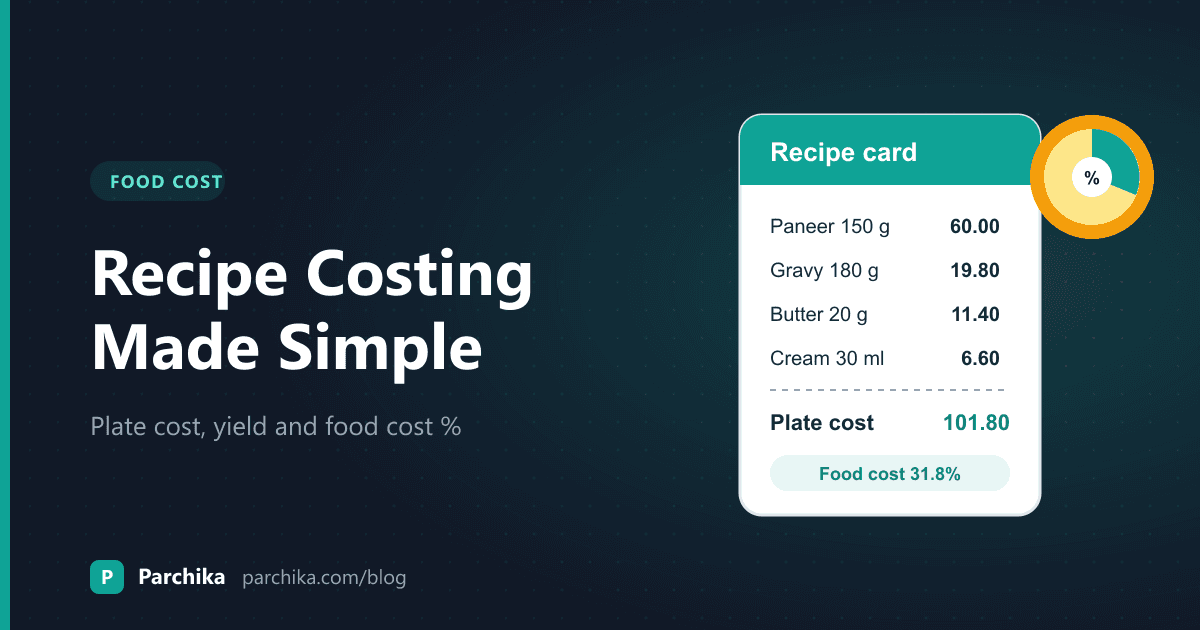
- Paneer, 150 g at ₹400/kg = ₹60.00
- Makhani gravy, 180 g at ₹110/kg = ₹19.80
- Butter, 20 g at ₹570/kg = ₹11.40
- Fresh cream, 30 ml at ₹220/litre = ₹6.60
- Kasuri methi, sugar, garam masala, garnish = ₹4.00
Plate cost: ₹101.80
It sells for ₹320 before tax. So the food cost percentage is:
₹101.80 ÷ ₹320 × 100 = 31.8%
If your target for this dish is 30%, you have two choices. Raise the price to ₹101.80 ÷ 0.30 = ₹339, so round to ₹340. Or bring the plate cost down to ₹96 by trimming the paneer to 140 g and easing the cream down to 20 ml. Notice that paneer is 59% of the plate cost. That's the ingredient to watch, and the one where a heavy-handed cook hurts you most.
Food cost %, gross margin and markup are not the same thing
These three get mixed up all the time, especially when an owner and an accountant are talking past each other. They all come from the same two numbers but answer different questions.
Take a dish that costs ₹30 and sells for ₹100.
At a glance
Three ways to read the same ₹30 cost and ₹100 price
| Feature | Food cost % | Gross margin % | Markup % |
|---|---|---|---|
| Formula | Cost ÷ price × 100 | (Price − cost) ÷ price × 100 | (Price − cost) ÷ cost × 100 |
| Result for this dish | 30% | 70% | 233% |
| Question it answers | How much of the price goes on ingredients? | How much of the price is left over? | How far above cost did I price it? |
| Who usually uses it | Kitchen and menu planning | Owners and accountants | Retail and bakery counters |
Food cost % and gross margin always add up to 100. Markup doesn't, which is why "we keep a 200% markup" sounds generous but is actually a 33% food cost. The food cost calculator shows all three side by side, so you can check a price before it goes on the menu.
What food cost percentage should you aim for?
A common rule of thumb for full-service restaurants is somewhere around 28% to 35%. Treat that as a starting point, not a rule.
It depends on what you sell. A cafe selling coffee, where the beans and milk in a cappuccino cost very little, can run well under 25% on beverages. A steak or seafood place may run higher and still make good money because each plate brings in more rupees of profit. And a bakery making its own bread from flour has a very different cost structure from one that buys in finished items.
So don't chase one number across the whole menu. Look at each dish's percentage and the rupees of profit it makes. A ₹60 masala chai at 20% food cost earns you ₹48. A ₹450 biryani at 35% earns you ₹292. You'd rather sell more biryani, even though its percentage looks worse.
Recipe cost vs actual food cost: the gap is the story
Everything above gives you theoretical food cost. It's what you should spend if every plate is made exactly to recipe.
Your actual food cost comes from your stock, not your recipes:
Actual food cost % = (opening stock + purchases − closing stock) ÷ food sales × 100
For example, say a restaurant starts the month with ₹85,000 of stock, buys ₹2,40,000 more, and ends with ₹75,000 on the shelves. It used ₹2,50,000 of food. Food sales were ₹7,80,000. Actual food cost is 32.1%.
Now multiply each dish's recipe cost by how many were sold, and say that comes to 29.5% of food sales. That 2.6-point gap is about ₹20,000 for the month. It's going somewhere: over-portioning, wastage nobody logged, staff meals, a supplier short-delivering, or the odd kilo of paneer walking out the back door.
You won't find it unless you count stock regularly. Weekly is better than monthly. By the time a monthly count shows a problem, you've already lost four weeks of money.
Keep your recipe costs current
A recipe cost sheet from last Diwali is fiction by now. Tomato and onion prices can swing hard within a single season.
At minimum, re-cost your top sellers whenever a main ingredient changes price by more than about 10%, and do a full review every quarter. That's tedious on a spreadsheet. It's the main reason most restaurants cost their menu once, when they open, and never again.
How Parchika helps
Start with the free food cost calculator if you just want to check one dish. Enter what it costs to make and what you sell it for, and it gives you food cost %, gross margin and markup.
When you're ready to stop doing it by hand, Parchika's Pro plan includes recipes (BOM) linked to your purchases and stock. You set up each recipe with exact quantities, including sub-recipes like gravies and doughs. Every bill then deducts the ingredients from stock automatically, so your theoretical usage is always up to date. Record your physical counts and the theoretical vs actual report shows where the gap is. You can also log wastage with a reason, so "burnt" and "customer return" stop disappearing into one number.
Run a kitchen that makes its own products in batches? Parchika can also cost each production batch from the raw materials actually used. Our post on bakery production planning walks through how that works, and the restaurant inventory software page covers stock in more detail. Plan details are on the pricing page.
Know what every plate really costs
Start billing free on Parchika, then add recipes and stock tracking when you're ready.
Still have questions?
Frequently asked questions
What is the formula for food cost percentage?
Food cost percentage is the cost of the ingredients in a dish divided by its selling price, multiplied by 100. A dish that costs ₹90 to make and sells for ₹300 has a 30% food cost. Use the price before tax, not the tax-inclusive price.
Should I include packaging in recipe costing?
Yes, for takeaway and delivery items. Containers, lids, bags and cutlery are a direct cost of that order. Many restaurants keep a separate delivery recipe for the same dish so the packaging is costed properly.
How do I cost spices and small ingredients?
You can cost them properly by weight, but most kitchens add a fixed amount per plate, such as ₹3 to ₹5, to cover salt, spices, oil for tempering and garnish. Check that figure every few months against what you actually spend on these items.
How often should I update my recipe costs?
Re-cost a dish whenever one of its main ingredients changes price noticeably, and review the whole menu at least once a quarter. If your recipes are linked to purchase prices in your POS, this happens as you enter supplier bills.
Why is my actual food cost higher than my recipe cost?
The usual causes are over-portioning, unlogged wastage, staff meals, wrong yields in the recipe, supplier short-deliveries and theft. Count stock weekly and compare it with what your recipes say you should have used. The size of the gap tells you how much to dig.
Written by
Parchika POS
POS Software Experts
The Parchika team of restaurant and retail technology specialists fact-checks and curates industry best practices.