
In this article· 7 sections
- 01Where the bake plan usually goes wrong
- 02Step 1: Work out how much of each product to bake
- 03Step 2: Turn the bake plan into an ingredient list
- 04Step 3: Record every bake as a batch
- 05Step 4: Track shelf life and sell what expires first
- 06Step 5: Write down everything you throw away
- 07How Parchika helps with bakery production planning
It's 8 pm. Twenty-two sweet buns are still in the case, the croissants sold out at 3, and tomorrow you'll probably bake the same amounts again because that's what the notebook says.
Bakery production planning is how you break that cycle. It's the daily habit of deciding what to bake, how much, from which dough, and then following every batch until it's sold or written off. This guide walks through it in five steps: a simple formula for bake quantities, sub-recipes, batch records, the real cost of each item, and shelf life. There are worked examples with numbers you can copy. You don't need software to start. But you'll see where it saves you time, and where a bakery production planning system does the sums for you.
Where the bake plan usually goes wrong
Most bakeries don't plan production. They repeat it. The head baker bakes what they baked last Saturday, adds a tray if the weather's nice, and cuts back after a bad day.
That works until it doesn't. The usual leaks:
- Bread and buns over-baked on slow days, then discounted or binned at closing.
- Best-sellers gone by mid-afternoon, so the customer walks to the bakery next door.
- Flour and butter stock that never matches the books, because nobody deducts what the bakehouse actually used.
- A bake stopped halfway because the cream ran out.
- Custom cake orders written in a separate diary, so the bakehouse finds out about 40 extra cupcakes at 6 am.
None of these feel dramatic on a single day. Added up over a month, they're a real slice of your margin. And fixing them is mostly about routine, not baking skill.
Step 1: Work out how much of each product to bake
Here's the formula. It isn't clever, and that's the point:
Bake quantity = expected sales + booked orders − fresh stock already on the shelf
- Expected sales. Take what the product sold on the same weekday over the last four weeks and average it. Same weekday matters. A Saturday and a Tuesday are different businesses.
- Adjust for what you know. Festival, school holiday, a big match, heavy rain. Move the number up or down and note why, so you can check later whether you were right.
- Add booked orders. Custom cakes, party orders, wholesale and cafe supply. They go in the same plan, not a separate diary.
- Subtract fresh stock. Only count items that will still sell at full price tomorrow.
- Round to your tray size. Ovens bake trays, not single buns.
Worked example: sweet buns for a Saturday
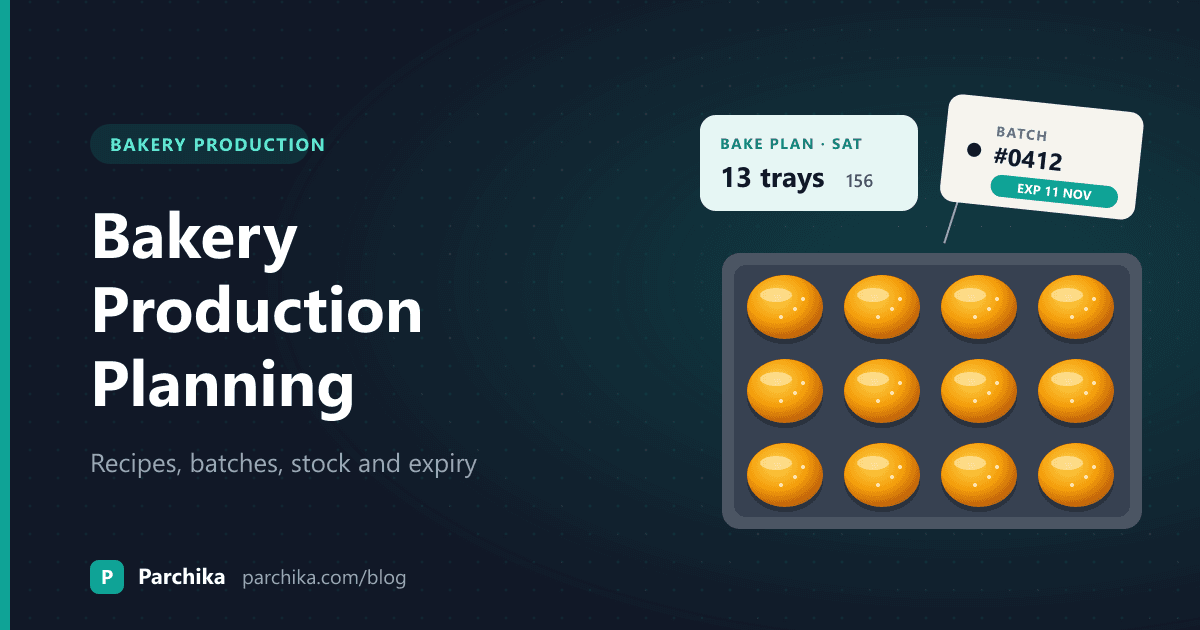
Say your sweet buns sold 118, 124, 109 and 121 on the last four Saturdays. That averages to 118. You also have a booked order for 40 buns from a school event. Buns are baked fresh every morning, so shelf stock is zero.
118 + 40 − 0 = 158 buns. Your trays hold 12, so that's 13.2 trays.
Thirteen trays (156) or fourteen (168)? We'd bake thirteen. Two buns short means a couple of customers pick something else. Ten buns over means ten in the discount bin at 8 pm. For short shelf-life products, a slight under-bake usually costs you less than an over-bake. For long-life items like rusks and cookies, round up instead. They'll sell tomorrow.
Step 2: Turn the bake plan into an ingredient list
A bake plan in units (156 buns, 40 croissants, 30 sandwich loaves) doesn't help the person weighing flour at 4 am. They need kilos.
This is where recipes earn their keep, and sub-recipes in particular. Most bakery products share a base. One sweet dough becomes buns, cinnamon rolls and dinner rolls. One sponge batter becomes three different cakes. Set the dough up once as its own recipe. Then each product uses a weight of that dough, plus its own extras like filling, glaze or topping.
Now the maths does itself. If 156 buns take 60 g of dough each, that's 9.36 kg of sweet dough. Add the cinnamon rolls and dinner rolls and you get one total for the day's sweet dough mix, broken down into flour, sugar, butter, yeast and milk.
Then check that list against the store room before anyone starts mixing. Finding out you're 2 kg short on butter at 5 am is how a bake stops halfway. Finding out at 4 pm the day before is just a call to your supplier.
Step 3: Record every bake as a batch
Every time something comes out of the oven, record it as a batch: a batch number, the bake date, how many you planned and how many you actually got.
That last number is the one people skip. It's also the one that matters most. Planned and actual yield are rarely the same. Dough sticks to the bowl, a few buns come out misshapen, one tray catches at the back of the oven. If you never write down the real yield, your costs are guesswork.
Worked example: what one sweet bun really costs
Here's a sweet dough batch with illustrative prices. Swap in your own.
- Flour, 5 kg at ₹40/kg: ₹200
- Butter, 0.6 kg at ₹500/kg: ₹300
- Milk, 2.5 L at ₹60/L: ₹150
- Eggs, 10 at ₹7: ₹70
- Sugar, 0.8 kg at ₹45/kg: ₹36
- Yeast, 100 g: ₹30
- Salt and improver: ₹10
That's ₹796 for roughly 9.6 kg of dough.
On paper, at 60 g a bun, you get 160 buns at ₹4.98 each. But this batch gave you 148 good buns. Divide by the real yield and each bun costs ₹5.38. That's about 8% more than you thought, before glaze, gas, power or wages.
If you priced the bun on the paper number, that 8% came straight off your margin. You can run your own recipes through the food cost calculator to see where each product really stands.
Batch records give you something else too: traceability. If a customer complains about a cake, you can see which batch it came from, when it was baked and what went into it. You hope you'll never need that. The day you do, you'll be glad it's there.
Step 4: Track shelf life and sell what expires first
Give every product a shelf life. Bread might be two days, cream pastries one, cookies and rusks a few weeks, depending on your recipes and storage. Once each batch has a bake date and the product has a shelf life, every batch has its own expiry date.
Then the counter rule is simple: sell whatever expires first. That's FEFO, first expiry, first out. It's a little different from FIFO, first in, first out, which sells the oldest stock first.
For a product baked fresh every day, the two are the same thing. But they split more often than you'd think. Take cookies. Say Monday's batch went into sealed jars with a 30-day life, and Wednesday's batch went loose into the counter tray with a 7-day life. Wednesday's batch is newer, yet it expires first. FIFO would push the jars. FEFO pushes the loose cookies, which is what you want.
In practice:
- Label trays and boxes with the batch or expiry date, not just the product name.
- Set a near-expiry warning a day or two ahead for longer-life items, so you can move them (a combo, a staff suggestion, a small discount) before they turn into dead stock.
- Bake short-life items like bread and buns closest to opening time. Save cookies and rusks for the slower hours.
Step 5: Write down everything you throw away
Waste you don't record is waste you'll repeat. At closing, every item that can't be sold tomorrow goes in the log with a reason: unsold, burnt, damaged, expired, staff meal. Log it against the batch.
After two or three weeks, patterns turn up. Maybe Tuesday's croissants are always a dozen over. Maybe one oven position burns a few every bake. Maybe the chocolate cake clears but the plain sponge never does. Each of those is a change to tomorrow's plan, and that's the whole loop: plan, bake, record, sell, log, adjust.
It feels like paperwork at first. It's ten minutes a night. And it's the only part of this process that makes next month's plan better than this month's.
At a glance
Notebook and spreadsheet vs bakery production software
| Feature | Notebook or spreadsheet | Bakery production software |
|---|---|---|
| Bake quantities | Last week's numbers, from memory | Suggested from weekday sales, orders and shelf stock |
| Custom cake orders | Kept in a separate diary | Added to the same bake plan |
| Ingredient list | Worked out by hand each morning | Calculated from recipes and sub-recipes |
| Shortfall check | Found during the bake | Flagged before baking starts |
| Batch and yield records | Rarely kept | Every bake, planned vs actual |
| Ingredient stock | Updated by hand, often days late | Deducted when each batch is completed |
| Expiry tracking | Checked by eye on the shelf | Batch-level dates with near-expiry alerts |
| Cost per item | Theoretical, rarely updated | From actual ingredient use and yield |
How Parchika helps with bakery production planning
You can run all of this on paper, and plenty of good bakeries do. The trouble is that the numbers live in three places (the counter, the bakehouse diary and the store room) and nobody has time to join them up at 4 am.
Parchika's bakery production software joins them because the bake plan sits in the same system as your bakery POS. Here's what that looks like day to day:
- It suggests bake quantities per product from sales history by weekday, booked cake and bulk orders, and fresh stock already on the shelf. Your head baker adjusts the numbers before confirming.
- Doughs, batters, creams and fillings are set up once as sub-recipes and reused across products.
- The confirmed plan becomes an ingredient list, with any shortfall flagged before baking starts.
- Each bake is recorded as a batch with its actual yield. Ingredients are deducted automatically and finished goods go into stock.
- A shelf life per product gives every batch an expiry date, with near-expiry alerts and first-expiry, first-out selling.
- Write-offs are logged against the batch with a reason, and batch costing shows the true cost of each item.
If you supply several outlets from one bakehouse, outlet requests and transfers work much like a central kitchen setup. Production management comes with Parchika's Enterprise plan. Check pricing for the current details.
Plan tomorrow's bake from today's sales
Bake plans, batches and expiry dates, connected to your bakery counter.
Still have questions?
Frequently asked questions
How do I work out how much bread to bake each day?
Average what each product sold on the same weekday over the last four weeks, then adjust for anything you know about, like a festival or heavy rain. Add booked orders, subtract fresh stock you can still sell at full price, and round to your tray size. For short shelf-life items, rounding down slightly usually wastes less.
What's the difference between FIFO and FEFO in a bakery?
FIFO sells the oldest stock first. FEFO sells the stock that expires first. They're the same for products baked fresh daily, but they differ when batches of one product have different shelf lives, for example sealed packs versus loose counter stock. For perishable food, FEFO is the safer rule.
What is a sub-recipe in bakery production?
A sub-recipe is a base you make once and use in several products, such as a sweet dough, sponge batter, pastry cream or filling. Products then use a weight of the sub-recipe plus their own extras. It makes the daily ingredient list accurate and saves you from re-entering the same dough in ten recipes.
Why is my real cost per item higher than my recipe cost?
Usually because the recipe cost assumes the theoretical yield. Dough loss, misshapes and burnt trays mean you get fewer good pieces than planned, so each one costs more. Divide the batch cost by the actual number of good pieces to get the real figure.
How can a bakery reduce end-of-day wastage?
Plan bake quantities from recent sales instead of habit, sell the soonest-expiring stock first, and log every write-off with a reason. After a few weeks the log shows which products and days are over-baked, and you can cut those quantities.
Written by
Parchika POS
POS Software Experts
The Parchika team of restaurant and retail technology specialists fact-checks and curates industry best practices.