
In this article· 8 sections
- 01What is an indent in a restaurant?
- 02Why informal indents fail
- 03How an outlet should calculate its indent
- 04Worked example: indents from four outlets
- 05The daily indent cycle: a checklist
- 06Fulfilling indents: partial supply, substitutions and records
- 07Common indent mistakes to avoid
- 08How Parchika helps with restaurant indent management
Every evening, the outlet manager sends the central kitchen a message: "Need base sauce, marinated chicken, some dough." No quantities, or quantities guessed from memory. The next morning the outlet runs out of sauce by 2 pm, while another outlet throws away half a tub of marinade.
Restaurant indent management is the process that fixes this. An indent (also called a requisition) is a formal request from an outlet to the central kitchen or store for a specific quantity of an item, by a specific time. In this guide you will learn how outlets should calculate their indents, when to send them, how the central kitchen should consolidate and fulfil them, and the mistakes that cause shortages and waste.
If you run a central kitchen and want the bigger picture first, read our guide to central kitchen management for multiple outlets.
What is an indent in a restaurant?
An indent is an internal order. The outlet is the customer, and the central kitchen (or central store) is the supplier. A good indent answers four questions:
- What item is needed (using the same item name and unit the central kitchen uses)
- How much, in a fixed unit such as kg, litres or portions
- By when, usually the next dispatch slot
- Who raised it, so there is someone to call if a number looks wrong
Indents are different from purchase orders. A purchase order goes to an outside supplier and creates a bill. An indent moves stock between locations of the same business. The money does not leave the company, but the cost still needs to move with the stock so each outlet's food cost is correct.
Most chains use indents for semi-finished items made in the central kitchen (base sauces, marinated proteins, doughs, desserts) and for packaged raw materials held in a central store (rice, oil, spices, disposables).
Why informal indents fail
Indents sent by phone or WhatsApp work when you have one or two outlets. As the chain grows, the same problems show up again and again:
- Free-text quantities. "2 tubs" means different things to different people. The kitchen has to guess.
- No cut-off time. Late requests arrive after production has started, so the kitchen either cooks a second small batch or the outlet goes short.
- Nothing to consolidate. The production manager copies numbers from five chat threads into a notebook. One number is missed and an outlet is short the next day.
- No link to stock. The outlet asks for what it usually asks for, not what it actually needs after counting what is already in the chiller.
- No record of what was sent. When the outlet says it received less than it asked for, nobody can check.
The fix is not more messages. It is a fixed process with fixed units, fixed times and one place where all indents are collected.
How an outlet should calculate its indent
The most reliable method for daily indents is par level minus stock on hand. A par level is the quantity of an item the outlet should hold at the start of a trading day to get through it comfortably.
Step 1: Set a par level for each item
Start with average daily usage, then add a small buffer for busy days:
Par level = average daily usage × (1 + buffer %)
Use the last two to four weeks of sales to work out usage. If you sell 40 pasta portions a day and each portion uses 150 g of tomato base sauce, daily sauce usage is 6 kg. With a 15% buffer, the par level is about 6.9 kg, so round to 7 kg.
Set different par levels for weekdays and weekends if your sales differ a lot between them.
Step 2: Count what is on hand
Count the item at closing time, in the same unit as the par level. Only count usable stock: anything past its expiry or close to it should not be counted as available.
Step 3: Subtract and round to pack size
Indent quantity = par level − usable stock on hand
Then round up to the pack size the central kitchen dispatches in. If sauce goes out in 2 kg tubs and you need 4.6 kg, request 3 tubs (6 kg), or 2 tubs (4 kg) if you would rather run slightly short than waste.
Step 4: Adjust for known events
A booked party, a festival, a local holiday or a promotion should change the indent. Add the expected extra covers on top of the par calculation and note the reason, so the central kitchen does not think it is a mistake.
Worked example: indents from four outlets
Here is an illustrative example for one item, tomato base sauce, dispatched in 2 kg tubs. Each outlet calculates its own indent from its par level and closing stock:
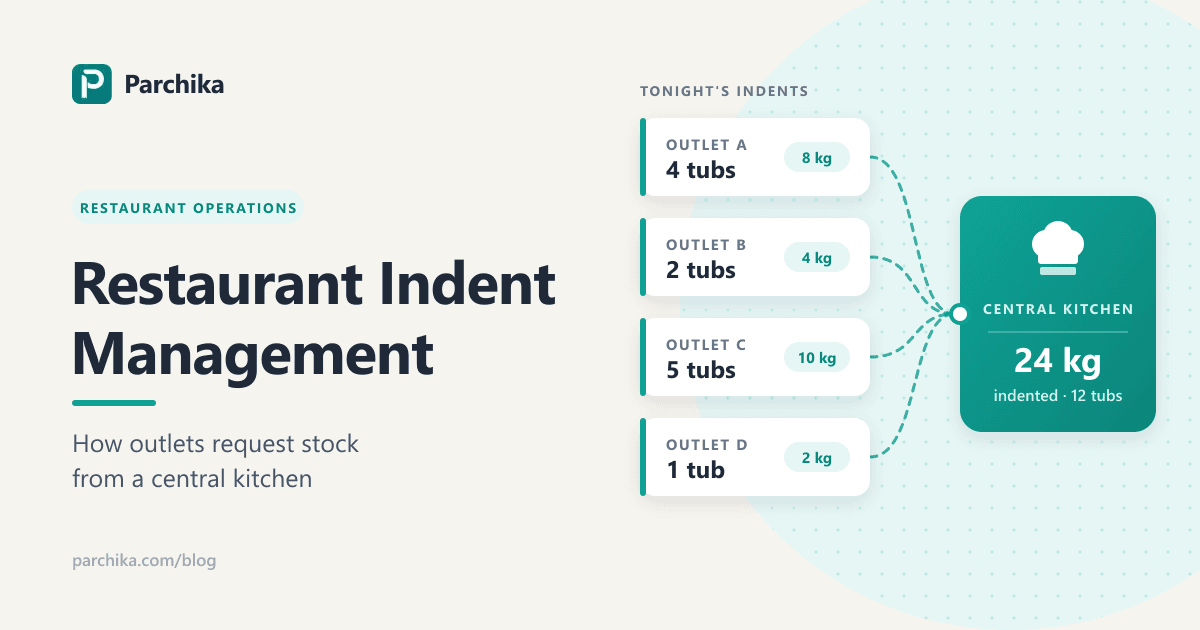
- Outlet A: par 8 kg, on hand 1.5 kg, needs 6.5 kg, indents 4 tubs (8 kg)
- Outlet B: par 6 kg, on hand 2 kg, needs 4 kg, indents 2 tubs (4 kg)
- Outlet C: par 10 kg, on hand 0.5 kg, needs 9.5 kg, indents 5 tubs (10 kg)
- Outlet D: par 5 kg, on hand 3 kg, needs 2 kg, indents 1 tub (2 kg)
Total indented: 12 tubs, or 24 kg.
The central kitchen already holds 4 kg of yesterday's sauce that is still within its shelf life. So it only needs to produce 20 kg today. That 4 kg should also be the first stock dispatched, because it expires first.
Now the recipe does the rest. Say the sauce recipe makes a 10 kg batch and uses 8 kg tomatoes, 1.5 kg onions, 0.6 litre olive oil, 0.2 kg garlic and herbs. Two batches (20 kg) need 16 kg tomatoes, 3 kg onions, 1.2 litres olive oil and 0.4 kg garlic. If the store has only 12 kg tomatoes, the production manager knows before cooking starts, not halfway through the second batch.
This is the real value of structured indents: one total per item, a production quantity after subtracting existing stock, and a raw material list you can check against the store.
The daily indent cycle: a checklist
A fixed daily rhythm matters more than any tool. Here is a simple cycle that works for most chains with a morning dispatch:
- Closing (outlet): count usable stock of every indented item after service.
- Indent cut-off: outlets submit indents by a fixed time, for example 11 pm, or 2 hours after closing. Late indents roll to the next dispatch.
- Consolidation (central kitchen): combine all indents into one total per item, subtract finished stock already held, and get the production quantity.
- Raw material check: convert the production quantity into raw materials using standard recipes. Raise purchase orders or move stock from the central store for any shortfall.
- Production: cook in batches. Record each batch with its quantity, production date and expiry date.
- Picking and dispatch: pick each outlet's indent, oldest batch first, and send a dispatch note listing items, quantities and batch details.
- Receiving (outlet): check the delivery against the dispatch note and record any shortage, damage or temperature issue before signing.
- Review: each week, compare indented, dispatched, received, sold and wasted quantities by outlet.
If an outlet needs something urgently mid-day, allow an emergency indent, but track how often it happens. Frequent emergency indents usually mean the par level is too low.
At a glance
Ways to manage restaurant indents
| Feature | Phone / WhatsApp | Shared spreadsheet | Indents in the POS |
|---|---|---|---|
| Fixed items and units | Partly | ||
| Cut-off time enforced | Depends on setup | ||
| Indents combined automatically | Manual formulas | ||
| Linked to outlet stock and sales | |||
| Raw material needs calculated | Manual | ||
| Batch and expiry sent with stock | |||
| Transfer cost charged to outlet | Manual |
Fulfilling indents: partial supply, substitutions and records
The central kitchen will not always be able to send everything. When it cannot, decide the rules in advance instead of arguing about them at 6 am.
Partial fulfilment
If there is not enough of an item, decide how to share it. Common rules are: in proportion to each outlet's indent, or priority to the outlets with the highest sales. Whatever you choose, record the dispatched quantity separately from the indented quantity, so the outlet knows what is coming and the shortfall shows up in reports.
Substitutions
If the kitchen sends a substitute (for example a different marinade), record it as its own item on the dispatch note. Never let it be received under the original item name, or the outlet's stock and recipes will be wrong.
Transfer cost
Every transfer should carry a cost: the batch cost per unit multiplied by the quantity sent. This puts central kitchen items into each outlet's food cost. Without it, outlets look more profitable than they are, and the central kitchen looks like an unexplained expense. If you need help working out cost per unit, use the food cost calculator.
Common indent mistakes to avoid
- Indenting by habit. Asking for "the usual" every day ignores stock on hand and creates waste.
- Mixed units. One outlet indents in kg, another in tubs, another in portions. Fix one unit per item.
- Counting expired stock as available. It makes the indent too small and the outlet runs short.
- No receiving check. If outlets sign for deliveries without checking, you cannot tell whether a shortage happened at dispatch or at the outlet.
- Ignoring returns and wastage. If an outlet keeps throwing away the same item, its indent is too high. Track wastage per item, per outlet.
- Over-ordering to be safe. Outlet managers often pad indents because they fear running out. Clear par levels and reliable dispatch times remove the reason to pad.
For a deeper look at counting and reorder points at the outlet level, see our guide to restaurant stock counts.
How Parchika helps with restaurant indent management
Parchika central kitchen software handles the indent cycle in the same system your outlets use for billing:
- Outlet requisitions: outlets raise indents for semi-finished and finished items, and the central kitchen sees them combined into one production plan.
- Raw material requirement: standard recipes (BOM), including sub-recipes such as base sauces and doughs, turn the plan into a raw material list and flag shortfalls before cooking starts.
- Batch production: each batch is recorded with its batch number, production date and actual yield, and raw materials are deducted automatically.
- Transfers with batch and expiry: stock goes to outlets with batch number and expiry date attached, so outlets can use it first-expiry, first-out.
- Transfer costing: transfers are charged to the receiving outlet at batch cost, so each outlet's food cost includes central kitchen items.
- Yield and wastage: planned and actual yield are compared for every batch, and wastage is logged with a reason code.
Because indents, stock and sales live in one system, you can check each outlet's indents against what it actually sold and wasted. See plans and pricing for which plan covers multiple outlets, or explore multi-outlet POS software.
Run your outlet indents through Parchika
Collect outlet requisitions, plan central kitchen production and transfer batches with expiry and cost attached.
Still have questions?
Frequently asked questions
What is the difference between an indent and a purchase order?
An indent is an internal request from an outlet to your own central kitchen or store. A purchase order goes to an outside supplier and leads to a supplier bill. Indents move stock and cost between your own locations.
How often should outlets send indents to the central kitchen?
Most chains use one daily indent with a fixed cut-off time after closing, matched to a morning dispatch. Busy outlets or items with a very short shelf life may need two dispatches a day. Keep emergency indents for genuine exceptions and track how often they happen.
How do I calculate an outlet's indent quantity?
Subtract usable stock on hand from the item's par level, then round to the central kitchen's pack size. Adjust upward for known events such as parties or holidays. Review par levels monthly against actual usage and wastage.
What should happen when the central kitchen cannot supply the full indent?
Agree a rule in advance, such as sharing stock in proportion to each indent or prioritising the busiest outlets. Record the dispatched quantity separately from the indented quantity so the outlet knows what to expect and the shortfall appears in reports.
Should outlets be charged for items from the central kitchen?
Yes, at least internally. Charging each transfer at batch cost puts central kitchen items into the outlet's food cost, so you can compare outlet profitability fairly and spot outlets that over-indent or waste.
Is an indent the same as a requisition?
Yes. Indent, requisition and store requisition are used interchangeably in restaurants. They all mean an internal request for stock from one location of the business to another.
Written by
Parchika POS
POS Software Experts
The Parchika team of restaurant and retail technology specialists fact-checks and curates industry best practices.